
/ Article
Three steps to maximise uptime and reduce costs
In this paper, we consider Huisman’s On-site Support services. These services, incorporating the three steps of efficient inspection & maintenance schedule, new tooling, and analysis & prediction, maintain the optimal performance of Huisman equipment for maximal uptime and reduced costs over the lifetime.
The first step covers the foundation of standardised inspections and maintenance. The standard plan draws on the requirements of multiple classification societies. The plan includes whether the equipment may be in operation, should be tested or should be turned off. This ensures efficient coordination of tasks and minimal interference with operations.
The second step is modern tooling. This paper considers examples such as drone technology, combined with AI, to advance safety, efficiency and quality of inspections, as well as mobile wire rope inspection systems.
The third step is predictability. Huisman has five dashboards in development that focus on optimising equipment and operations. These will help to reduce financial and operational risks and strengthen current and future business.
Step 1: Efficient inspection and maintenance
The maintenance manual is developed, based on criticality analyses of various types of equipment. This includes FMECA’s and RAMS analyses and their criticality matrices, which conclude in mitigating actions. This analysis together with Huisman’s service experience, forms the preventive maintenance advice.
The maintenance schedule divides the equipment into its component parts with an Equipment Breakdown Structure (EBS). Depending on the type of equipment, the division can be made into components such as power and control, structural, hoist systems, etc.
The inspection and maintenance topics are further categorised into topic groups. This includes, for example, control systems, electrical, hydraulic, structural, cooling systems, and so on.
Following this, the schedule offers the following information:
- activity required
- interval (typically one yearly, five-yearly, or ten-yearly)
- origin (Huisman or classification society)
With this, the structure is in place to ensure that each component part of the equipment receives the care it needs, when it needs it, by the person most qualified to do it.
Step 2: New tooling
In addition to an efficient maintenance schedule, Huisman uses modern tooling for on-site support, increasing safety, efficiency and, ultimately, uptime.
Inspections by drone
Huisman uses drones as an extension of the periodic inspection. The innovative aspect of this is its use of AI. Taking an established AI system, Huisman trained it to inspect equipment. It quickly identifies damage, categorises it as a dent, rust, etc. and recommends corrective action. Huisman's clients are also able to use the AI system on their own drones.
Sending in a drone removes the requirement to set up rope access or scaffolding. There are a number of advantages associated with this:
- Safety. No one is required to work at height in a potentially hazardous environment.
- Efficiency. With no requirement to set up and subsequently remove scaffolding, the inspection can be carried out with significantly increased speed.
- Cost. The increased efficiency offers a lower cost for inspections, combined with increased uptime of the vessel and equipment.
- Track record. A history of the object's state (with hundreds or thousands of inspection points) in detail, with a history.
Wire rope monitoring
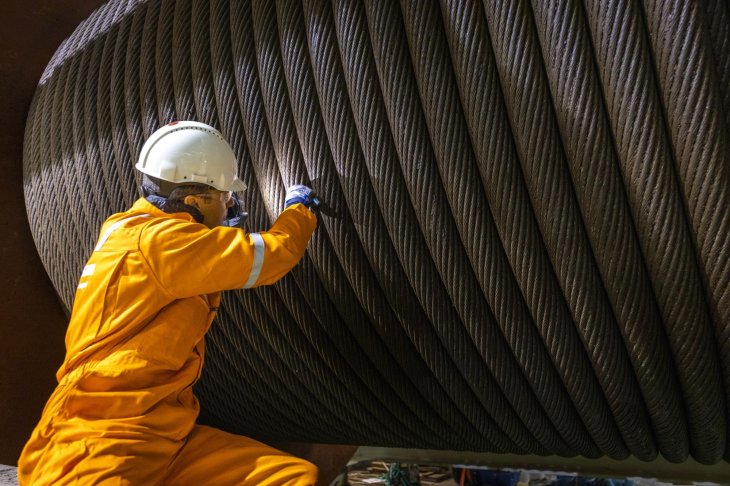
The wire ropes are a vital component in a wide range of onshore and offshore equipment. During its operational lifetime, the wire rope is subjected to significant wear and tear. The top three reasons for its deterioration are:
- Usage
- Faulty use
- Corrosion
Ensuring the optimal condition of the wire ropes improves safety, and reduces downtime, costs, and environmental impact. It is, therefore, essential to undertake regular periodic inspections.
Inspection tools
The most straightforward form of wire rope monitoring is the conventional human visual inspection. This is, however, time-consuming, challenging, unreliable and in most cases not documented properly to monitor the wear on the wire rope.
A more advanced approach is the Rope Vision inspection. This method applies a mobile system to conduct a semi-automated visual scope measuring the circumference of the rope along its length.
Once the wire rope runs through Rope Vision, multiple cameras take pictures of each side of the wire rope with a certain frequency to measure the diameter and detect anomalies. This provides valuable information on the status of the wire rope, based on which its lifetime can be predicted. By plotting this in graphs and pictures, a track record of the rope can be made, allowing our client to determine the amount of wear on the rope over time, and make it predictable.
Step 3: Analyse & predict
Huisman continues to develop its services offering with the aim of moving beyond the current scheduled/preventive model to a predictive maintenance model.
A key part of this is the myHuisman© client portal, a solution that is paving the way to increasingly digital, data-driven services.
myHuisman© provides a central location for all servicing needs, enabling rapid parts ordering, an overview of all enquiries and efficient access to remote and on-site support.
Combine field data with digital data
Huisman’s development of predictive maintenance is continuously optimised. To help inform advanced inspection and maintenance services, Huisman is outfitting its equipment with numerous sensors and will offer additional condition monitoring solutions. This data can then be brought together and presented in myHuisman© performance dashboard for analysis.
Usage vs design life data
The data gathered by the sensors during usage can be paired with the design life data to create the complete picture. For example, combining the number of lifts undertaken by a crane with the wear and tear observed in a wire rope over a specific period of time to predict the optimal moment for wire rope replacement.
Conclusion
The above examination of inspection and maintenance services demonstrates the importance of three steps to inspection and maintenance periods.
The basis of successful I&M is the creation of an effective maintenance schedule. While this should be flexible enough to consider the requirements of each piece of equipment, a standard approach provides the most efficiency and factors in the requirements of multiple classification societies.
Modern tooling provides an important boost to safety, efficiency and quality of inspections. This frequently includes the use of digital innovation.
Increasing digitalisation hints at the future of inspection and maintenance. With wider use of digital technology, such as AI, sensors located around the equipment and automated tooling as described in the sections above, it becomes possible to move beyond scheduled maintenance and towards predictive maintenance.
Digitalisation offers remote monitoring capabilities to predict the best moment to conduct maintenance. It allows the performance of maintenance prior to planned maintenance in case of anomalies of unforeseen wear, as well as after planned maintenance when the condition of e.g., a gearbox oil is OK, and replacement is not necessary.
The three steps described above, especially when combined with the original equipment manufacturer's in-depth understanding of the equipment and its design life data, provide a comprehensive picture. With this, the inspection and maintenance process can advance towards a predictive model. This offers a range of benefits including increased efficiency and performance, as well as cost reduction.